Picture this. Your customer needs a service you offer. But instead of opening Google, they open ChatGPT and ask, “Who’s the best agency for this?”
The AI gives them three names. None of them is yours.
Welcome to search in 2026. The rules have changed, and most brands haven’t caught up. The good news is that fixing this isn’t as hard as it looks. Let me walk you through it, step by step.
What is AI Visibility?
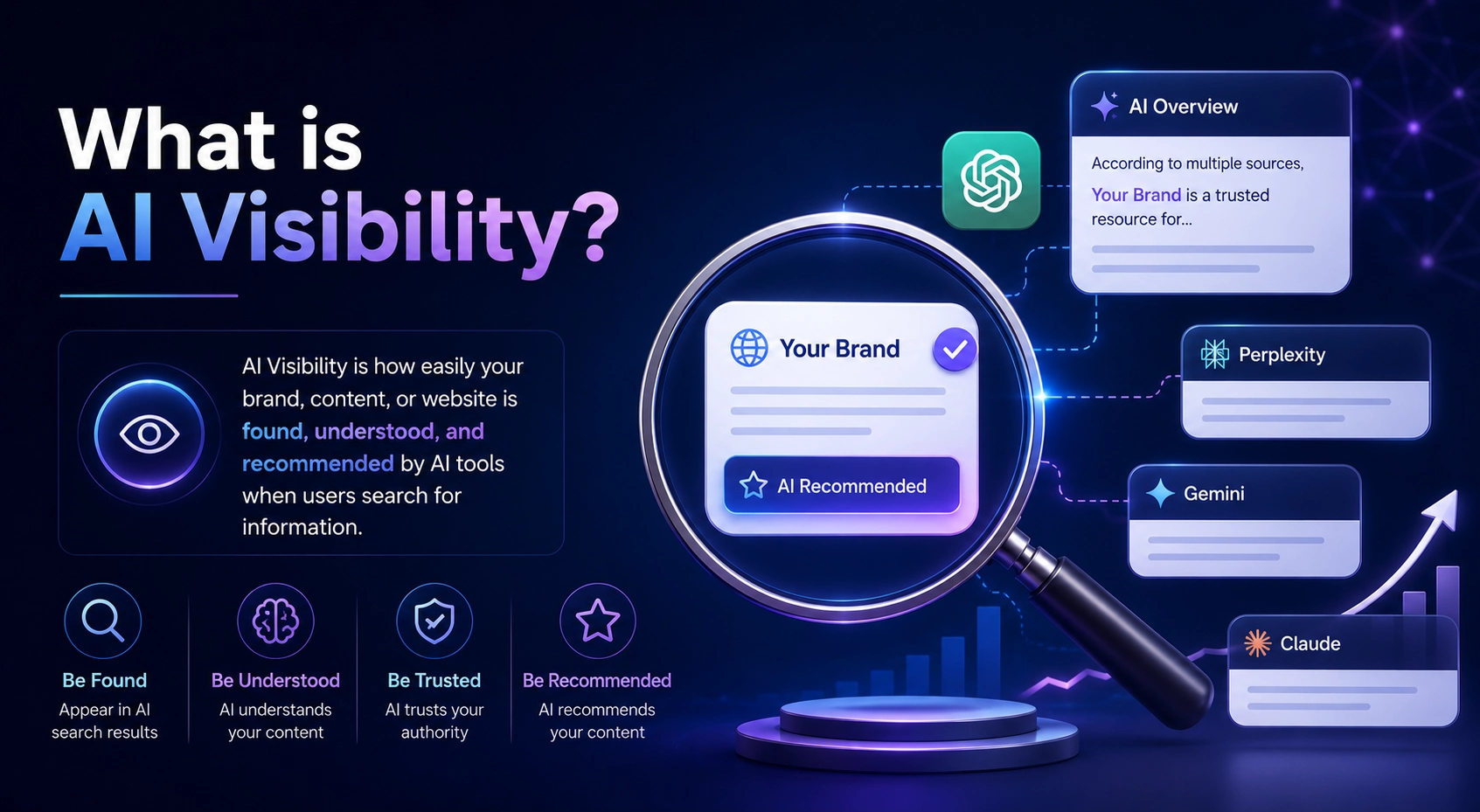
AI visibility is how often your brand shows up when people ask AI tools like ChatGPT, Perplexity, Google AI Overviews, Claude, or Gemini for answers.
Think of it like this. Traditional SEO was about being on the first page of Google. AI visibility is about being inside the answer itself.
Your brand can appear in two ways:
- A mention. The AI says your name in its answer.
- A citation. The AI mentions you and links to your page as a source. This is the stronger signal because it sends real traffic to your website.
Both matter. Mentions build awareness. Citations build trust and bring visitors. In 2026, you need both.
How Citations in AI Work
AI tools don’t pick citations randomly. They follow a clear process, and once you understand it, everything else makes sense.
Here’s what happens when someone asks an AI a question:
The AI breaks the question into smaller parts.
If someone asks "Best digital marketing agency for healthcare brands in India?", the AI splits it into pieces like "digital marketing agency India" and "healthcare marketing experts". This is called query fan-out.
Step 1The AI scans the web for each piece.
It looks at websites, Reddit threads, YouTube videos, Wikipedia pages, and review sites like G2 or Clutch.
Step 2The AI checks for agreement.
It looks for brands that appear consistently across several trusted sources. The more places confirm you, the more confident the AI feels about citing you.
Step 3The AI picks the most extractable answer
It prefers content that gives a clear, direct answer at the top of the page. Not buried in paragraph nine.
Step 4The AI writes the response and credits the sources.
That credit is your citation. Getting cited isn't about gaming an algorithm. It's about being clearly present, clearly stated, and clearly trusted across the places AI looks.
Step 5Quick Note: SEO vs AEO vs GEO
Three terms you’ll keep hearing:
SEO is ranking on Google's blue links. Still matters.

AEO (Answer Engine Optimization) is structuring your content so AI can extract direct answers from it.

GEO (Generative Engine Optimization) is making your brand show up inside AI-generated responses.
You don’t replace one with the other. You stack all three. Strong SEO still feeds AI search. Now, the steps.
Step 1: Open the Door for AI Crawlers
The biggest reason most brands are invisible in AI search isn’t bad content. It’s that they’re accidentally blocking the bots.
Open your website’s robots.txt file and make sure these AI crawlers are allowed in:
- GPTBot (ChatGPT)
- ClaudeBot (Claude)
- PerplexityBot (Perplexity)
- Google-Extended (Gemini and AI Overviews)
If your developer used a default Cloudflare setting, these are often silently blocked. Fix this first. Without it, nothing else matters.
Step 2: Answer the Question First, Tell the Story Second
AI tools love content that opens with the answer in the first two or three sentences.
If your page is titled “How to Choose an SEO Agency“, the first paragraph should answer that question directly. Save the long story for later.
Simple test: if someone could screenshot just the top of your page, would they get a complete answer? If yes, you’re doing it right.
Step 3: Add FAQ Sections to Your Pages
This one is small but powerful. AI tools love FAQ-style content because the question-and-answer format is easy to extract.
On every important page, add a short FAQ block at the bottom. Use question-style headings like “What is…” or “How do I…” that match what real people ask.
Add FAQ schema markup behind the scenes so the AI clearly understands each question and answer. Your developer can do this in 10 minutes.
Step 4: Back Up Your Claims with Evidence
AI tools trust content that looks credible. Vague marketing language (“we are leaders in innovative solutions”) gets ignored.
What works instead:
- Specific numbers (“we’ve helped 40 brands grow their organic traffic”)
- Named experts and quotes
- Real examples and short case studies
- Original data, surveys, or research from your team
Treat every claim like a court statement. If you can’t back it up, soften it or cut it.
Step 5: Show Up Where Your Buyers Already Ask Questions
This is the secret most brands skip. AI tools look for agreement across multiple platforms. You can’t only exist on your own website.
Build a small but consistent presence on:
- Reddit — genuine answers in relevant subreddits, not link drops
- LinkedIn — thought leadership posts from your founders and senior team
- YouTube — even short tutorial videos build authority
- Review sites — Clutch, G2, GoodFirms for B2B; Google Reviews for local
- Industry publications — guest articles, expert quotes, interviews
Think of it as planting flags. Every flag tells the AI, “This brand is real, and knows what it’s talking about.”
Step 6: Keep Your Content Fresh
AI tools, especially Perplexity, favor recent content. Anything older than three months starts losing visibility.
Two simple habits will fix this:
- Add a visible “Last Updated” date to your important pages.
- Pick your top 10 pages and update them every quarter. Real updates with new examples and fresh data, not just changing the date.
If 2026 makes sense in a title (like “Best SEO Tools in 2026”), use it. Year signals help AI tools know your content is current.
Step 7: Track What’s Working
You can’t improve what you don’t measure. Here’s the simple version:
- Set up a new “AI Traffic” channel in Google Analytics 4. Your developer can do this with a small regex rule that catches visits from ChatGPT, Perplexity, Claude, and Gemini.
- Once a month, type 20 questions your customers might ask into each AI tool. Note where you show up, where you don’t, and who’s showing up instead.
- Watch the trend over time, not just one snapshot.
Tools like Frase, Profound, or Ahrefs Brand Radar can automate this if you want to go deeper.
Common Mistakes to Avoid
A few quick ones that quietly kill AI visibility:
- Blocking AI bots without realising it
- Content that needs JavaScript to load (AI can't read it)
- Hiding key content behind tabs or accordions
- No named authors or expert bios
- Letting cornerstone pages go stale for a year
- Pure marketing fluff in the first paragraph
Fix these and you’re already ahead of most of your competitors.
Citation Growth Tip
AI search isn’t a passing trend. It’s the new front door to your business.
The brands that win in 2026 won’t be the ones with the loudest marketing. They’ll be the ones who show up clearly, consistently, and credibly across every place an AI looks for answers.
Start with the seven steps above. Pick one this week. Then the next. Within three months, you’ll start seeing your brand show up in places it never did before.
Frequently Asked Questions
1. How long does it take to get cited by AI search tools?
Getting cited by AI search tools usually takes 6 to 12 weeks of consistent work. Mentions appear first; citations follow once your brand is confirmed across several trusted sources. Brands that publish weekly and maintain presence on three or more platforms tend to get cited faster than those relying only on their own website.
2. Do AI citations from ChatGPT and Perplexity bring real website traffic?
Yes. AI citations include a clickable link to your page, so a citation in ChatGPT, Perplexity, or Google AI Overviews sends a real visitor to your site. Mentions build awareness without a link, while citations drive measurable referral traffic. In 2026, both signals matter, but citations are the ones that grow your numbers.
3. Is AEO replacing SEO in 2026?
No, AEO is not replacing SEO. Answer Engine Optimization works on top of SEO because AI tools still pull from Google’s search results to decide what to cite. A page ranking on page one of Google has a stronger chance of being quoted by an AI tool. The two work together, not against each other.
4. Which AI search platform should a business prioritize first?
A business should prioritize the AI platform its customers already use. ChatGPT and Perplexity drive the most reference traffic for B2B brands, while Google AI Overviews matters most for local businesses because it sits inside regular search results. Start with one platform, confirm it works, then expand to the others.
5. How can I tell if my website is blocking AI crawlers?
Check your robots.txt file at yoursite.com/robots.txt for four crawlers: GPTBot, ClaudeBot, PerplexityBot, and Google-Extended. If any are set to “Disallow,” AI tools cannot read your content. Cloudflare and several security plugins block these crawlers by default, so this is worth checking even if you never changed the setting yourself.
6. Does FAQ schema markup help a page get cited by AI?
Yes, FAQ schema markup helps AI tools cite a page by labeling exactly which text is a question and which is the answer. This structure makes content easier to extract and quote. Adding it takes a developer roughly 10 minutes per page and gives a page a clear advantage over competitors without structured data.
7. Can a small business outrank big brands in AI search results?
Yes, a small business can outrank big brands in AI search because AI tools reward clear, specific, well-sourced answers over domain size. A focused brand with named experts, real case studies, and consistent presence on Reddit, LinkedIn, and review sites like Clutch or G2 can get cited ahead of larger competitors that publish vague marketing copy.
8. How often should content be updated to stay visible in AI search?
Content should be updated every quarter to stay visible in AI search, with a visible “Last Updated” date on every important page. Perplexity in particular favors recent content, and pages older than three months begin losing visibility. Updating your top 10 pages with new examples and fresh data matters more than changing the date alone.
9. What is the difference between a mention and a citation in AI search?
A mention is when an AI tool says your brand name in its answer, while a citation is when it names you and links to your page as a source. Citations are the stronger signal because they send real traffic to your website and show the AI treats you as a trusted source. You want both, but citations carry more weight.
10. What is GEO (Generative Engine Optimization)?
GEO, or Generative Engine Optimization, is the practice of making your brand show up inside AI-generated answers from tools like ChatGPT, Perplexity, and Gemini. It differs from SEO, which targets Google’s blue links, and from AEO, which structures content for easy extraction. Most brands run all three together rather than choosing one.
11. What is query fan-out and why does it matter for AI citations?
Query fan-out is the process where an AI tool breaks a single question into smaller sub-questions before searching the web. A question like “best marketing agency for healthcare in India” splits into pieces such as “marketing agency India” and “healthcare marketing experts.” Matching your content to these smaller pieces increases the chance the AI finds and cites you.
12. Should the answer go at the top of my page or later in the article?
The answer should go in the first two or three sentences of your page. AI tools prefer content that states a clear, direct answer at the top rather than burying it deep in the article. A simple test: if someone screenshots only the top of your page, they should still get a complete answer.
13. Why does evidence matter for getting cited by AI?
Evidence matters because AI tools trust content that looks credible and skip vague marketing language. Specific numbers, named experts, real case studies, and original data all raise your chances of being cited. Treat every claim like a court statement, and if you cannot back it up, soften the claim or remove it.
14. Does posting on Reddit really help AI visibility?
Yes, posting on Reddit helps AI visibility because AI tools scan Reddit threads when looking for trusted opinions and confirmation across sources. Genuine, helpful answers in relevant subreddits work; link drops and self-promotion do not. Reddit is one of several off-site platforms, alongside LinkedIn, YouTube, and review sites, that signal your brand is real and credible.
15. Can JavaScript hurt my visibility in AI search?
Yes, content that needs JavaScript to load can hurt your AI search visibility because many AI crawlers cannot read it. If your key text, FAQs, or product details only appear after a script runs, the AI may see an empty page. Make sure your important content is present in the raw HTML, not loaded in later.
16. Do I need named authors on my content for AI citations?
Yes, named authors with real bios help your content get cited because AI tools look for signals of expertise and accountability. Anonymous content reads as less trustworthy. Add an author name, a short bio with relevant credentials, and a photo to cornerstone pages so the AI can connect the content to a real expert.
17. How do I track AI traffic in Google Analytics 4?
You track AI traffic in Google Analytics 4 by setting up a custom “AI Traffic” channel using a regex rule that catches referrals from ChatGPT, Perplexity, Claude, and Gemini. This separates AI-driven visits from regular search and social traffic. A developer can configure this in under 30 minutes so you can watch the trend month over month.
18. Which tools can track AI search visibility?
Tools like Frase, Profound, and Ahrefs Brand Radar can track AI search visibility and automate the process of checking where your brand appears. For a manual check, type 20 customer questions into each AI tool once a month and note where you show up and who appears instead. Watch the trend over time, not a single snapshot.
19. Does putting “2026” in my page titles help with AI search?
Yes, including the current year in titles like “Best SEO Tools in 2026” helps when the year is relevant, because it signals to AI tools that your content is current. AI search, especially Perplexity, favors recent content. Use the year only where it makes sense, and pair it with real updates so the freshness signal holds up.
20. Why isn’t my brand showing up in ChatGPT even though it ranks on Google?
Your brand may rank on Google but stay invisible in ChatGPT for a few reasons: AI crawlers could be blocked in your robots.txt, your content may load through JavaScript the AI cannot read, or your brand may not appear across enough trusted third-party sources. AI tools look for agreement across platforms, so existing only on your own site is rarely enough.