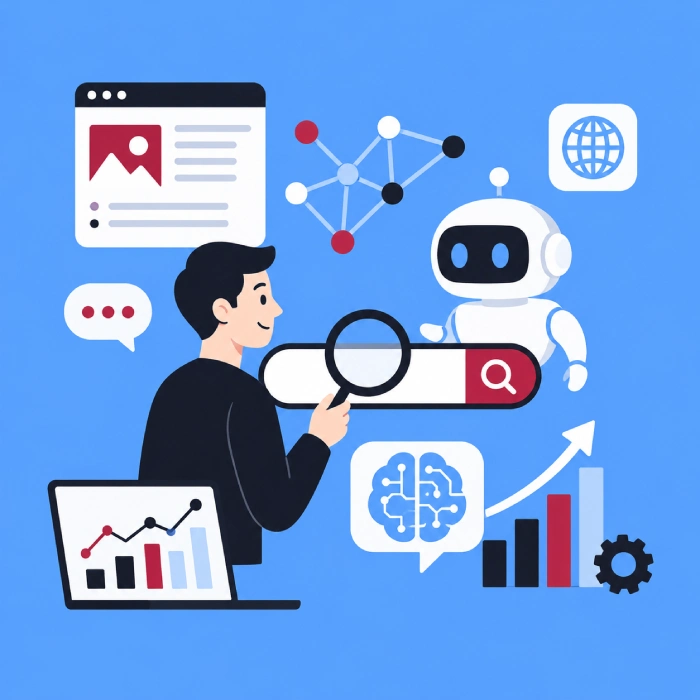
Are you still confused about using AI for your website’s SEO? Do you fear that Google will penalise your website? Well, all these questions are going to get answered today. Whether you’re a business owner, marketer, or blogger, understanding how to harness the power of artificial intelligence for SEO can give you a competitive edge. This beginner’s guide will help you understand the essentials of AI SEO, why it matters, and how to use it effectively to enhance your website’s visibility and search rankings.
What is AI SEO?
AI SEO, or Artificial Intelligence SEO, refers to the use of machine learning and AI technologies to improve your website’s search engine optimization strategies. From keyword research to content creation, AI tools automate and enhance SEO tasks with impressive speed and precision.
Unlike traditional methods that require manual data collection and analysis, AI SEO tools use algorithms to analyze user intent, keyword trends, content quality, and competitor strategies in real-time.
Why AI is Changing the SEO Game
The digital landscape is saturated with content, and search engines like Google are becoming smarter with algorithm updates. AI enables marketers to:
- Understand user behavior: AI tools can predict what your audience is looking for based on search history and behavioral data.
- Improve content quality: AI-powered platforms can suggest topic ideas, optimize existing content, and ensure readability.
- Automate time-consuming tasks: AI tools reduce the time spent on keyword research, backlink analysis, and competitor tracking.
By integrating AI into SEO strategies, you not only save time but also make data-driven decisions for better results.
Key Components of AI SEO
Let’s dive into the main components of AI-powered SEO and how they work together to drive organic traffic:
1. AI-Powered Keyword Research
Traditional keyword research can be tedious. AI SEO tools like Semrush, Ahrefs, Surfer SEO, and Clearscope use machine learning to identify high-ranking keywords, long-tail keyword variations, and user intent faster than ever.
These tools help in:
- Discovering keyword gaps
- Understanding seasonal trends
- Mapping content to searcher intent
- 2. Content Creation and Optimization
AI doesn’t just stop at finding keywords, it helps create content too. Tools like Jasper, Writesonic, and Copy.ai can generate blog posts, product descriptions, and even landing page copy with minimal input. Additionally, content optimization tools like Frase and MarketMuse score your content against top-ranking competitors and recommend changes to improve SEO.
3. Voice Search and Natural Language Processing (NLP)
Search engines are increasingly optimizing for voice search, which means your content needs to be more conversational and question-based. AI-driven SEO focuses on natural language processing (NLP) to ensure that your content aligns with how people actually speak and search. For example, instead of targeting the keyword “cheap flight tickets,” AI might suggest optimizing for “where can I find cheap flight tickets?”
4. Predictive SEO
With the help of AI, marketers can now predict which keywords or topics are likely to trend. Predictive SEO involves analyzing vast amounts of data to forecast user behavior and upcoming search trends. This allows you to create content before a topic becomes highly competitive, giving you a head start on ranking.
5. Technical SEO and Automation
AI can also help with technical SEO tasks like site audits, broken link detection, page speed analysis, and schema markup generation. Tools like Screaming Frog, Moz Pro, and Surfer SEO integrate AI to crawl your website and deliver technical recommendations.
Automating these tasks ensures that your site remains technically sound and optimized for search engines.
How to Get Started with AI SEO
Getting started with AI SEO may seem daunting at first, but following a few simple steps will ease the transition:
Step 1: Identify Your Goals
Define what you want to achieve with SEO. Whether it’s increasing website traffic, boosting conversion rates, or improving domain authority, having clear goals will help you select the right tools.
Step 2: Choose the Right AI SEO Tools
Depending on your objectives, pick tools that align with your needs. For example:
- For keyword research: Semrush, Ahrefs
- For content creation: Jasper, Copy.ai
- For optimization: Surfer SEO, Frase
- For site analysis: Moz Pro, Screaming Frog
Step 3: Analyze Your Competitors
Use AI tools to study your competitors’ keyword strategy, backlinks, and top-performing content. This insight will help you design a more effective content strategy.
Step 4: Create and Optimize Content
Start creating content that is informative, engaging, and optimized based on AI recommendations. Ensure that your headings, metadata, and internal links are all SEO-friendly.
Step 5: Monitor and Improve
AI SEO is not a one-and-done task. Regularly analyze your performance metrics, tweak your strategy, and keep up with search engine algorithm updates.
Pros and Cons of AI SEO
Here’s a quick look at what makes AI SEO powerful, and where you still need a human touch.
Pros:
- Faster data processing
- Real-time optimization suggestions
- Predictive content insights
- Automation of repetitive tasks
Cons:
- High-quality tools can be expensive
- Risk of over-reliance on automation
- Requires human creativity for emotional engagement
While AI can handle the heavy lifting, human input is essential for crafting stories, building trust, and connecting emotionally with your audience.
Conclusion
AI SEO isn’t just a trend, it’s the future of search engine optimization. As algorithms continue to evolve, AI will play an even bigger role in shaping how we create, optimize, and distribute content. By understanding the basics now, you’ll be ahead of the curve, equipped to adapt, and ready to dominate search rankings with smarter, data-driven strategies.
Whether you’re a small business owner or a digital marketing enthusiast, leveraging AI-powered SEO can elevate your online presence, increase your visibility, and ultimately grow your brand.
Frequently Asked Questions
What is the difference between traditional SEO and AI SEO?
Traditional SEO relies on manual keyword research, content creation, and optimization, whereas AI SEO uses machine learning and automation to analyze data, understand user intent, and optimize content more efficiently.
Can AI completely replace human SEO experts?
No, AI can significantly enhance SEO efforts by automating tasks and providing data-driven insights, but human creativity, strategic thinking, and emotional understanding are still essential for creating engaging and trustworthy content.
Are AI SEO tools suitable for beginners?
Yes, many AI SEO tools are beginner-friendly and come with tutorials, templates, and intuitive dashboards that make it easy for non-experts to start improving their website's SEO.
What are the best AI tools for SEO in 2026
Some of the top AI SEO tools in 2026 include Semrush for keyword research, Jasper and Copy.ai for content creation, Surfer SEO for optimization, and Screaming Frog for technical SEO audits.
Is AI SEO only useful for content marketing?
No, AI SEO goes beyond content. It’s useful for technical SEO audits, voice search optimization, user behavior prediction, backlink analysis, and even local SEO strategies.
How soon can I see results using AI SEO tools?
Results vary based on your niche, competition, and current website health. However, with consistent use of AI SEO tools and strategies, many users start seeing improvements in traffic and rankings within 2–3 months.